Synonyms
45+ Synonyms for Hippo: Meanings, Examples, and Best Alternatives
 By Ethan Cole·October 21, 2026
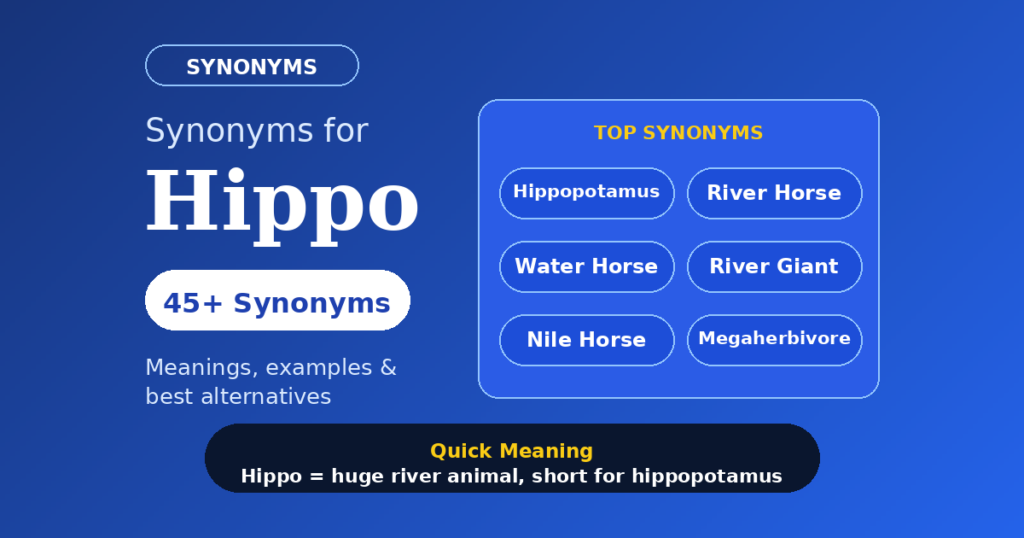
Quick Answer: Synonyms for Hippo
The closest synonyms for hippo are hippopotamus (the full formal name), river horse (what “hippopotamus” literally means in Greek) and water horse. Beyond those, writers swap in scientific names, old popular names like Nile horse, and descriptive alternatives such as river giant or megaherbivore. This guide collects 45+ synonyms for hippo and hippo alternatives, each with a plain meaning and an example, so you can pick the one that fits your sentence.
Table of Contents
- Quick Answer: Synonyms for Hippo
- What Hippo Means: Meaning, Tone and Context
- When and How to Use Hippo
- Another Word for Hippo
- When Not to Use Hippo
- Words Commonly Confused with Hippo
- Best Alternative for Hippo by Context
- Which Synonym for Hippo Should You Choose?
- Real-Life Examples of Hippo Synonyms in Sentences
- 45+ Synonyms for Hippo
- Synonym Groups and Usage Differences
- Antonyms for Hippo
- Hippo vs. Hippopotamus vs. River Horse: A Quick Comparison
- Common Phrases and Expressions with Hippo
What Hippo Means: Meaning, Tone and Context
Hippo is the short, everyday name for the hippopotamus, a huge semi-aquatic mammal that lives in the rivers and lakes of sub-Saharan Africa. A hippo spends its days mostly underwater, comes out at night to graze, and is famous for its barrel-shaped body, enormous jaws and surprisingly territorial temper.
The tone of “hippo” is friendly and informal. It is the word zoos, children’s books and news reports reach for. “Hippopotamus” sounds more formal and scientific, while older names like “river horse” carry a slightly literary flavour. One caution: “hippo” is also used as an unkind slang word for an overweight person, so in descriptions of people it can read as an insult — that is a context to avoid, not a synonym to use.
When and How to Use Hippo
Use hippo in everyday writing, travel pieces, nature writing for general readers, and any sentence where a relaxed tone matters more than scientific precision. Use hippopotamus or Hippopotamus amphibius in school reports, encyclopedia-style writing and scientific contexts. Reach for a descriptive alternative — river giant, megaherbivore — when you have already used “hippo” twice in a paragraph and need variety without changing the subject.
Another Word for Hippo
If you only need one another-word-for-hippo answer, take hippopotamus. It means exactly the same animal and works in every sentence where “hippo” works. For a more colourful swap, river horse is the classic: it is the literal translation of the Greek words hippos (horse) and potamos (river) that gave the animal its name. The full table below gives you 45 options, from exact names to looser descriptive phrases.
When Not to Use Hippo
Do not shorten to “hippo” in a scientific paper, a species list or a formal report — there, the full name shows you know the subject. Do not use the animal names in this list for the pygmy hippo unless you adjust them: the pygmy hippo is a different, much smaller species. And never use “hippo” as a nickname for a person; in that sense it is mocking, and words like “behemoth” applied to people are no kinder.
Words Commonly Confused with Hippo
| Word | What It Actually Means | How It Differs from Hippo |
|---|---|---|
| Rhino (rhinoceros) | A large African/Asian mammal with one or two horns on its nose | Has horns and stays on land; a hippo has no horn and lives partly in water |
| Manatee (sea cow) | A gentle, fully aquatic mammal of warm coastal waters | Smaller, fully aquatic, and no threat; “sea cow” is sometimes wrongly used for hippo |
| Pygmy hippo | A separate, much smaller hippo species from West African forests | A real hippo relative, but not the common hippo most people mean |
| Behemoth | A biblical creature; today, anything enormous | Often linked to the hippo, but it is a figure of speech, not the animal’s name |
| Buffalo | A large wild cattle species | A land grazer often seen in the same safari photos, but a different animal entirely |
Best Alternative for Hippo by Context
| Context | Best Choice | Why It Fits |
|---|---|---|
| School report or exam | Hippopotamus | Formal and precise |
| Scientific writing | Hippopotamus amphibius | The official Latin name |
| Children’s story | Hippo / river horse | Short, friendly and easy to picture |
| Travel or safari blog | River horse / river giant | Colourful without losing the reader |
| News report | Hippopotamus | Neutral and standard |
| Avoiding repetition | Megaherbivore / the animal | Keeps the paragraph fresh |
Which Synonym for Hippo Should You Choose?
Ask two questions. First: how formal is the piece? Formal writing takes hippopotamus or the Latin name; everything else is happy with hippo or river horse. Second: have you already said “hippo” in this paragraph? If yes, pick a descriptive alternative from the table — river giant for colour, semi-aquatic mammal for a textbook feel. Exact names first, descriptions second: that order keeps your writing accurate and lively at the same time.
Real-Life Examples of Hippo Synonyms in Sentences
Hippo Synonyms at School
For her science project, Amina wrote that the hippopotamus can hold its breath underwater for about five minutes. The teacher praised the class for spotting the river horse hiding in their Greek-roots word list.
Hippo Synonyms at the Workplace
The safari lodge’s newsletter announced that a baby hippo had been born near the north lagoon. In the conservation report, the team referred to the species by its scientific name, Hippopotamus amphibius.
Hippo Synonyms in Writing
The travel writer described a river giant surfacing at dusk, ears twitching above the waterline. In the poem, the old Nile horse stood for everything slow, heavy and ancient in the valley.
Hippo Synonyms in Conversation
“Did you see the hippo yawn at the zoo? Those teeth are unreal.” “Careful — Dad calls the neighbour’s dog a little water cow when it hogs the paddling pool, and Mum is not amused.”
45+ Synonyms for Hippo
Here is the full list. The first rows are exact names for the animal; the later rows are the scientific, older and descriptive alternatives that writers genuinely use in its place. Every one of these 45 synonyms for hippo comes with a simple meaning and an example.
| Synonym | Simple Meaning | Example Sentence |
|---|---|---|
| Hippopotamus | The full formal name of the hippo | The hippopotamus is one of the largest land mammals on Earth. |
| River horse | The literal Greek meaning of “hippopotamus” | The river horse rose from the muddy water with only its eyes showing. |
| Water horse | An old alternative name for the hippo | Early travellers called the animal a water horse because it swam like one wading. |
| Nile horse | Old name from the hippos of the Nile region | Ancient Egyptian art is full of the Nile horse carved in stone. |
| Common hippopotamus | The larger of the two living hippo species | The common hippopotamus is the species visitors see on most safaris. |
| Hippopotamus amphibius | The scientific (Latin) name of the common hippo | Hippopotamus amphibius is listed as vulnerable on the Red List. |
| River cow | A folksy old name (a female hippo is also called a cow) | The guide joked that the river cow was guarding her calf nearby. |
| Water cow | Another old popular name for the hippo | Victorian nature books often labelled the hippo a water cow. |
| Sea cow | A loose old name, now properly used for the manatee | Old sailors’ tales mixed up the sea cow with the hippo of the rivers. |
| Behemoth | The biblical giant often identified with the hippo; now means anything huge | The behemoth hauled itself onto the bank and shook off the river. |
| African river horse | Descriptive name stressing where it lives | The African river horse spends the hot hours in the shallows. |
| River giant | Descriptive alternative for a very large hippo | A river giant blocked the narrow channel, and the boat waited. |
| Water giant | Descriptive alternative for the hippo in water | The water giant surfaced silently beside the reeds. |
| River beast | A dramatic descriptive swap for hippo | The river beast charged, and the fishermen scattered. |
| River titan | A colourful, emphatic descriptive name | At three tonnes, the river titan feared almost nothing. |
| Megaherbivore | A scientific term for plant-eaters over one tonne | The hippo is a megaherbivore that shapes whole river ecosystems. |
| Large herbivore | A plain descriptive phrase for the hippo | Few large herbivores are as dangerous as the hippo when surprised. |
| Hefty herbivore | A light, informal descriptive phrase | This hefty herbivore eats around 40 kilograms of grass a night. |
| Heavyweight herbivore | A playful descriptive phrase for its bulk | The heavyweight herbivore of the river world defends its stretch fiercely. |
| Semi-aquatic mammal | A textbook description of the hippo’s lifestyle | A semi-aquatic mammal, the hippo lives half in water, half on land. |
| Amphibious mammal | A mammal at home in water and on land | The amphibious mammal grazes ashore only after dark. |
| Aquatic mammal | A loose description of its water-loving life | Tourists expect an aquatic mammal to be graceful; the hippo is anything but. |
| River mammal | A simple descriptive phrase | No river mammal marks its territory quite like the hippo does. |
| Thick-skinned mammal | A description based on its famously thick hide | The thick-skinned mammal secretes a pink fluid that works as sunscreen. |
| Pachyderm | An old-fashioned grouping for thick-skinned giants | The pachyderm wallowed happily while the elephants browsed nearby. |
| Ungulate | A hoofed mammal, which the hippo is | It surprises people that this ungulate is related to whales. |
| Even-toed ungulate | The scientific grouping (order) the hippo belongs to | As an even-toed ungulate, the hippo is kin to pigs and deer. |
| Artiodactyl | The scientific name for even-toed ungulates | Every artiodactyl in the park, hippo included, was counted at dawn. |
| Grazer | An animal that feeds on grass | The grazer leaves the water at dusk to crop the floodplain short. |
| Nocturnal grazer | A grazer that feeds at night, like the hippo | By day it dozes in the river; the nocturnal grazer feeds till sunrise. |
| Wetland grazer | A grazer of marshes and floodplains | The wetland grazer keeps channels open for fish and birds. |
| River grazer | A grazer tied to the riverbank | Paths worn by the river grazer criss-cross the bank. |
| Barrel-bodied beast | A vivid description of the hippo’s shape | The barrel-bodied beast squeezed through a gap in the reeds. |
| Big-mouthed grazer | A description of its huge gape | The big-mouthed grazer can open its jaws almost 180 degrees. |
| Territorial grazer | A description of its defensive behaviour | Boat crews give the territorial grazer a very wide berth. |
| Marsh dweller | An animal that lives in marshy places | The marsh dweller shares its pool with herons and crocodiles. |
| River dweller | An animal that lives in or by a river | Few river dwellers are as vocal at night as the hippo. |
| Water dweller | A general description of its habitat | The water dweller’s nostrils seal shut when it dives. |
| Mud-lover | An affectionate description of its wallowing habit | The mud-lover coats itself to keep cool and bite-free. |
| Mud-wallowing mammal | A mammal that rolls in mud, as hippos do | The mud-wallowing mammal emerged wearing a coat of grey clay. |
| Snorting river horse | A descriptive phrase from its loud calls | A snorting river horse answered from across the water. |
| Two-tonne grazer | A description based on its typical weight | The two-tonne grazer can still outrun a person over short ground. |
| Grey giant | A short descriptive name from its colour and size | The grey giant slipped beneath the surface without a ripple. |
| Hippo bull | A male hippo | The old hippo bull chased every rival from his stretch of river. |
| Hippo cow | A female hippo | The hippo cow nursed her calf in the shallow backwater. |
Synonym Groups and Usage Differences for Hippo
Exact names (hippopotamus, river horse, water horse, Nile horse) can replace “hippo” anywhere. Scientific names (Hippopotamus amphibius, artiodactyl, even-toed ungulate) belong in reports and textbooks. Old popular names (river cow, water cow, behemoth) add period colour but can confuse modern readers — “sea cow” today means the manatee. Descriptive phrases (river giant, nocturnal grazer, mud-lover) are not true synonyms at all; they are writer’s substitutes that keep a paragraph alive once the animal is already identified.
Antonyms for Hippo
A single animal has no true opposite, so these antonyms for hippo are contrasts writers and quizzes use — small, land-only or gentle animals set against the hippo’s size, habitat and temper.
| Antonym / Contrast | Why It Contrasts | Example Sentence |
|---|---|---|
| Pygmy hippo | The miniature relative — a fraction of the size | Next to the common hippo, the pygmy hippo looks almost dainty. |
| Mouse | Among the smallest mammals, against one of the largest | The mouse slipped through grass the hippo would flatten. |
| Manatee | Gentle and harmless where the hippo is territorial | The manatee drifts peacefully where a hippo would charge. |
| Desert camel | A creature of dry land, against a creature of water | The desert camel stores water; the hippo simply lives in it. |
| Gazelle | Light, slim and fast against heavy and barrel-bodied | The gazelle danced away as the hippo lumbered after it. |
Hippo vs. Hippopotamus vs. River Horse: A Quick Comparison
All three name the same animal. Hippo is the clipped, modern, friendly form — fine almost everywhere. Hippopotamus is the full dictionary form, best for formal writing. River horse is the oldest name of the three, a translation of the Greek original, and today it reads as charming rather than scientific. If a style guide is silent, match the word to the audience: children get hippos, examiners get hippopotamuses, and storytellers get river horses.
Common Phrases and Expressions with Hippo
- Hungry Hungry Hippos — the classic children’s board game; used jokingly for any frantic scramble for food.
- A hippo in the room — a playful twist on “the elephant in the room,” for an obvious problem nobody mentions.
- Happy as a hippo in mud — perfectly content in your element, from the hippo’s love of wallowing.
- Hippo-sized — informal shorthand for enormous: “a hippo-sized appetite.”
To sum up: the safest synonyms for hippo are hippopotamus and river horse, the most precise is Hippopotamus amphibius, and the most colourful are the descriptive swaps like river giant and megaherbivore. Pick by formality, vary them across a page, and your writing about this remarkable animal will never sound repetitive.
Discover More
Reference: Merriam-Webster Thesaurus: hippo

Written by
Ethan Cole
Ethan Cole writes the Synonyms and vocabulary guides at SyntaxMio. A former copyeditor, he loves finding the exact word for the exact moment — and explaining the small differences between words that look the same but are not.