Confused Words
Steam or Steem: What’s the Real Difference (And Which One Should You Use?)
 By Lily Morgan·October 21, 2026
You lift the kettle lid and a white cloud floats up. Later, a friend texts you about earning “steem” from a blog post. Same sound, two spellings — and your spell-checker happily accepts both. So which one belongs where?
Good news: this pair is easier than it looks. One is an everyday English word; the other is a name from the internet world. Once you see that split, you will never mix them up again.
First Things First: What Does “Steam” Mean?
Steam is, before anything else, the soft white gas that water turns into when it boils. You see it above a cup of tea and in a hot shower. As a verb, you can steam vegetables or steam a shirt.
The word has two more modern lives. Steam with a capital S is also the huge online store where people buy computer games. And in school, STEAM is an acronym for Science, Technology, Engineering, Arts, and Maths.
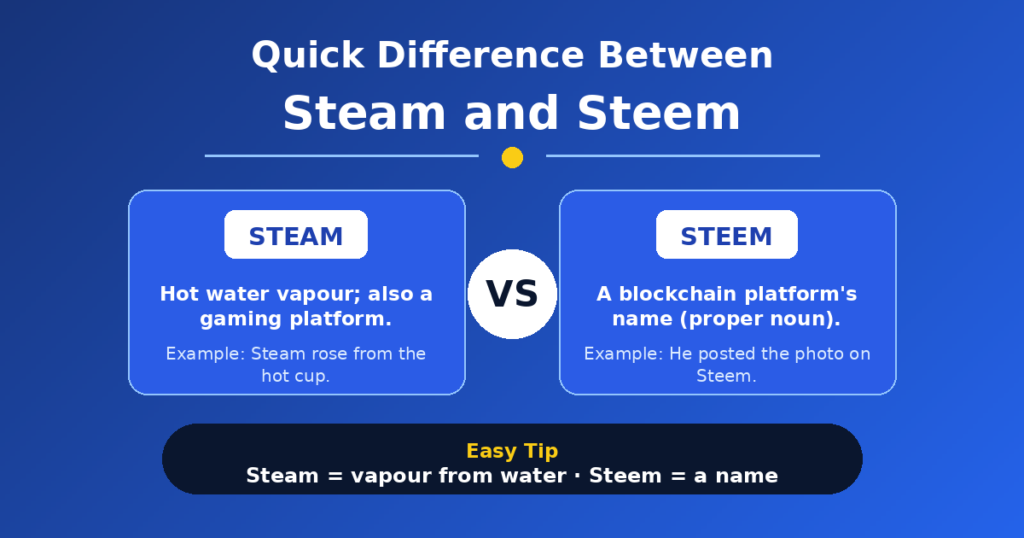
Steam is the vapour from hot water — and also a famous gaming platform and school acronym.
Where You See Steam in Real Life
- The cloud above a boiling pot or a fresh cup of coffee
- A bathroom mirror fogging up during a hot shower
- Old trains and big factories powered by steam engines
- The Steam app on a computer, full of games
Why Steam Matters
- It is one of the most common everyday science words in English.
- It appears in cooking, cleaning, travel, and weather talk.
- The gaming platform name shows up in tech news all the time.
If hot water is anywhere in the picture, steam is your answer.
Now, What Is “Steem”?
Steem is not a normal dictionary word at all. It is a proper name — a blockchain network launched in 2016, best known for powering Steemit, a blogging site where writers earn digital tokens when readers upvote their posts.
The name plays on “esteem,” meaning respect or value. Because it is a brand name, it keeps its unusual double-e spelling everywhere.
Steem is a blockchain platform and cryptocurrency that rewards people for online content.
The Idea Behind Steem
- Writers and creators earn tokens instead of only “likes.”
- Everything runs on a public blockchain, not one company’s server.
- The tokens can be traded like other cryptocurrencies.
Real-Life Example
Imagine a travel blogger who posts her photo story on Steemit. Readers upvote it, and she earns Steem tokens she can later convert into money. In that world — and only there — the double-e spelling is correct.
Why People Confuse Steam and Steem
The mix-up is easy to understand once you look closely:
- They sound exactly the same when spoken aloud.
- Spell-checkers accept both because both are “real” strings of letters.
- The difference is a single vowel pair: ea versus ee.
Steam vs Steem: Side-by-Side Comparison
The whole difference on one screen:
| Feature | Steam | Steem |
|---|---|---|
| Type | Common noun and verb | Proper noun (brand name) |
| Meaning | Water vapour; also a gaming platform | A blockchain network and its token |
| Usage | Kitchens, bathrooms, trains, gaming PCs | Crypto blogs and the Steemit website |
| Origin/Spelling | Old English word, spelled with “ea” | Invented name, plays on “esteem,” spelled “ee” |
| Context | Everyday English, all ages | Niche tech and investing circles |
| Example | Steam rose from the hot soup. | He earned Steem for his article. |
How to Use “Steam” Correctly
- Use steam when you write about boiling water, vapour, or cooking.
- Use it as a verb for cooking gently or removing wrinkles.
- Capitalise it only for the gaming store or the school acronym.
- If a sentence is about daily life, steam is almost always right.
Natural Examples
“Steam curled up from the mug of hot chocolate.”
“Please steam the dumplings for ten minutes.”
“He bought the game on Steam during the winter sale.”
How to Use “Steem” Correctly
- Use Steem only for the blockchain, its token, or its community.
- Never use it for vapour, engines, or cooking.
Natural Examples
“She converted her Steem tokens into dollars.”
“The Steem blockchain records every post publicly.”
“New users can earn Steem by writing on Steemit.”
A Simple Trick to Remember the Difference
- Think of TEA: hot tea makes steam, and both words share the letters ea.
- Think of ESTEEM: Steem contains the same double e as the respect it is named after.
- If you can see it, touch it, or cook with it — ea. If it lives on a blockchain — ee.
Two little vowel pairs, two different worlds.
Where You Might See These Words Online
Steam (Common Usage)
- Recipes telling you to steam rice or vegetables
- Game reviews and sale announcements from the Steam store
- School pages listing STEAM clubs and classes
Steem (Niche Usage)
- Crypto price charts listing the STEEM token
- Steemit blog posts about earning from writing
- Forum threads debating blockchain social media
Interesting Fact You Probably Didn’t Know
Steam has been part of English for over a thousand years, and steam power quite literally built the modern world. Steam engines pulled the first trains and drove factory machines long before petrol or electricity took over.
Steem, meanwhile, is younger than many smartphones. When its network launched in 2016, the idea that a blog post could pay its author directly — without ads or a publisher — felt radical.
So one word powered the industrial age, and the other tried to reinvent the internet age. Not bad for a single vowel swap.
Common Mistakes to Avoid
Watch out for these three classic slips:
❌ Using “steem” for hot water
Wrong: “Steem was coming out of the kettle.”
Right: “Steam was coming out of the kettle.”
❌ Spelling the token with “ea”
Wrong: “He sold his Steam tokens for cash.”
Right: “He sold his Steem tokens for cash.”
❌ Capitalising the everyday word
Wrong: “The bathroom filled with Steam after my shower.”
Right: “The bathroom filled with steam after my shower.”
Which One Should You Use?
Ask yourself one quick question — is this about the physical world or a crypto platform?
- → Steam for vapour, cooking, engines, irons, the game store, and school STEAM.
- → Steem only for the blockchain network, its tokens, and Steemit.
- In doubt? Everyday writing almost always wants steam.
Final Thoughts
Steam and Steem are a perfect example of how one tiny change in spelling can move a word into a different universe. One rises from your morning tea; the other lives in digital wallets.
Once you connect steam with tea and Steem with esteem, the choice becomes automatic.
Quick question: the cloud above your soup — steam or steem? (Kettle world, so steam, every time.)
Discover More
Reference: Merriam-Webster Dictionary: steam

Written by
Lily Morgan
Lily Morgan covers Confused Words at SyntaxMio. She helps learners untangle the pairs everyone mixes up — their/there, affect/effect, its/it's — with simple tests you can run in your head before you hit send.